
Big band
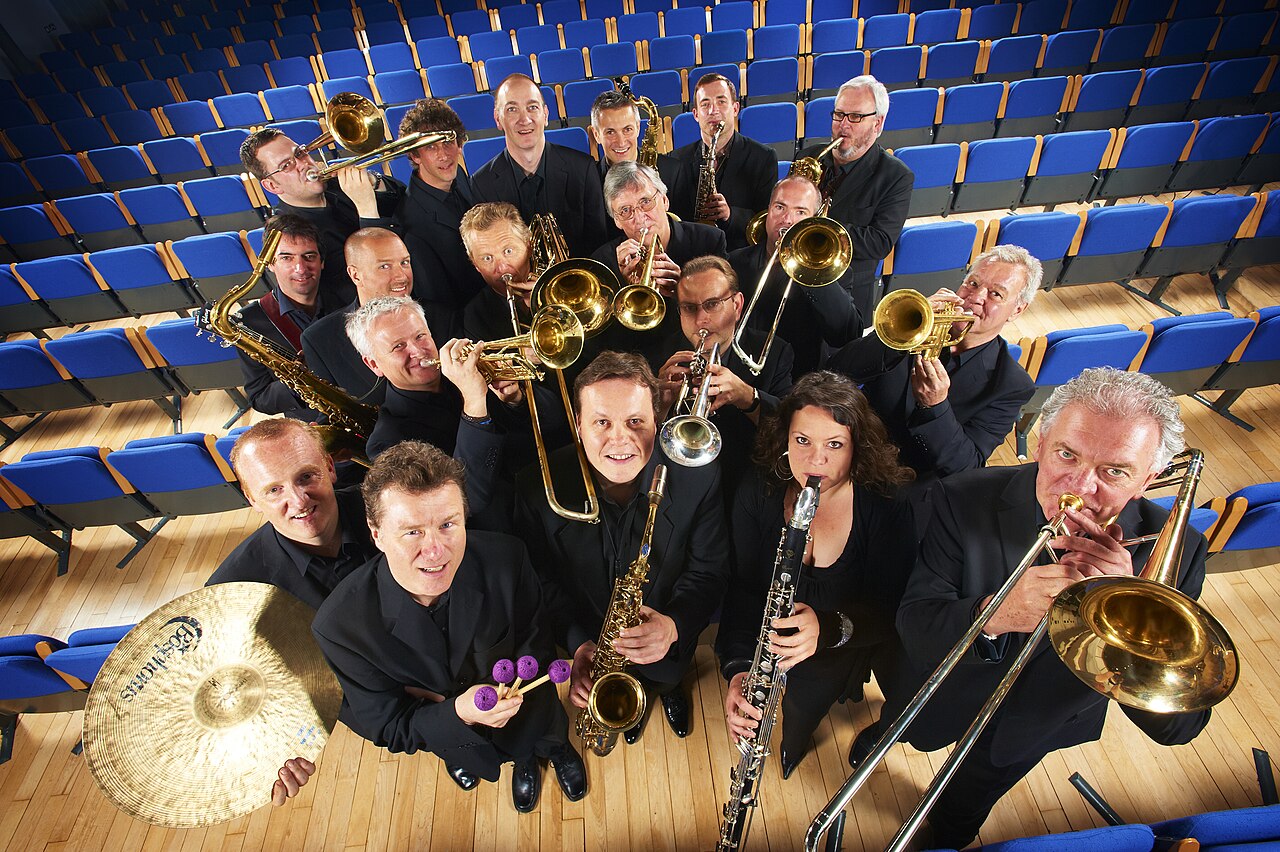
Large jazz ensemble with written arrangements and four instrumental sections.

Stuart Wood · Public domain
A big band, historically referred to as a jazz orchestra, is a type of musical ensemble of jazz music that usually consists of 10 or more musicians with four sections: saxophones, trumpets, trombones, and a rhythm section. Big bands originated during the early 1910s and dominated jazz in the early 1940s when swing was most popular. The term 'big band' is also used to describe a genre of music, although this was not the only style of music played by big bands. Big bands started as accompaniment for dancing the Lindy Hop. In contrast to the typical jazz emphasis on improvisation, big bands relied on written compositions and arrangements, giving a greater role to bandleaders, arrangers, and sections of instruments rather than soloists.
- originated
- early 1910s
- peak popularity
- early 1940s
- typical size
- 10 or more musicians
- sections
- saxophones, trumpets, trombones, rhythm section
- associated dance
- Lindy Hop
Lore & Background
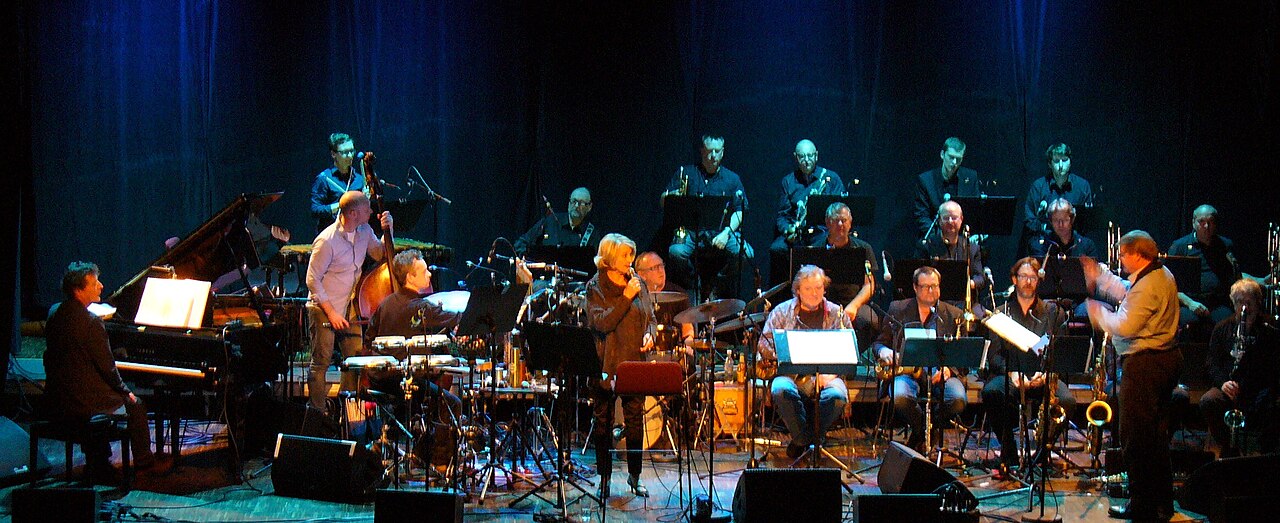
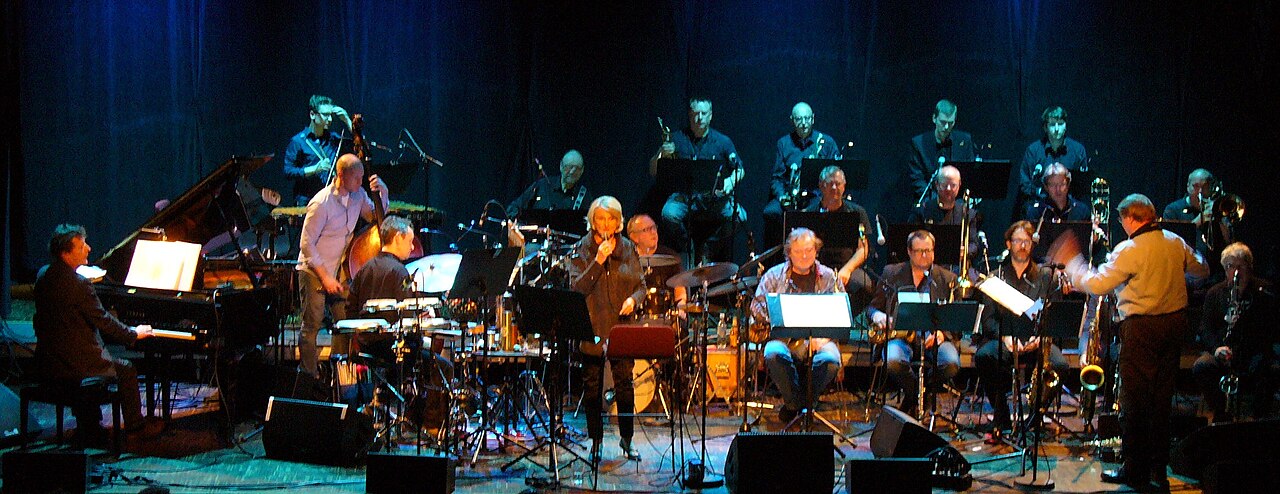
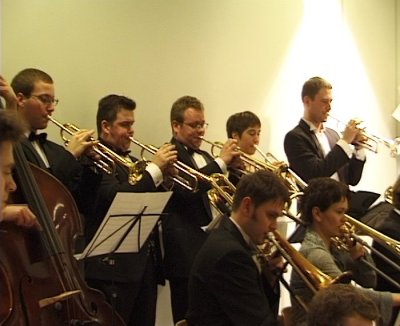
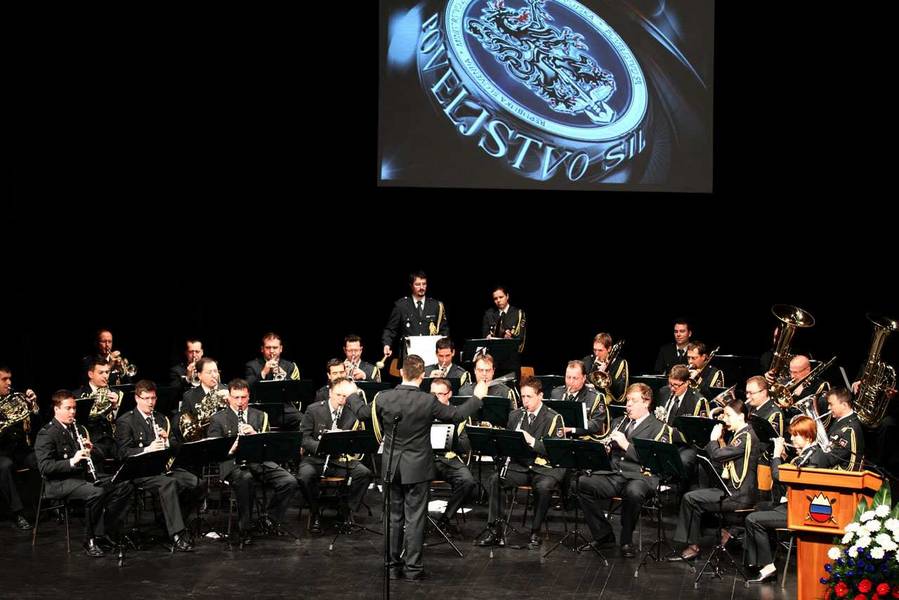
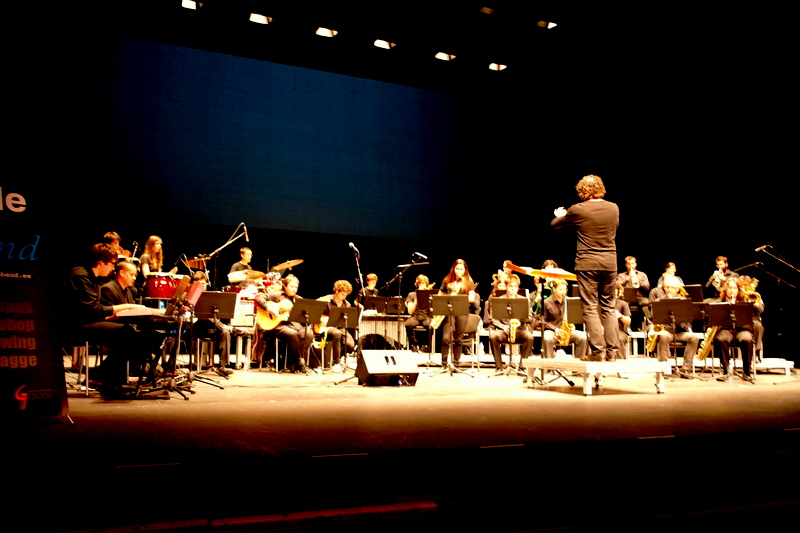
Big bands generally have four sections: trumpets, trombones, saxophones, and a rhythm section of guitar, piano, double bass, drums and sometimes vibraphone or other percussion. The division in early big bands, from the 1920s to 1930s, was typically two or three trumpets, one or two trombones, three or four saxophones, and a rhythm section of four instruments. In the 1940s, Stan Kenton's band used up to five trumpets, five trombones, five saxophones, and a rhythm section. Duke Ellington at one time used six trumpets. While most big bands dropped the previously common jazz clarinet from their arrangements, many Duke Ellington songs had clarinet parts. Boyd Raeburn drew from symphony orchestras by adding flute, French horn, strings, and timpani to his band. In the late 1930s, Shep Fields incorporated a solo accordion, temple blocks, piccolo, violins and a viola into his Rippling Rhythm Orchestra. Paul Whiteman also featured a solo accordion in his ensemble. Jazz ensembles numbering eight, nine, or ten voices are sometimes called 'little big bands'. During the 1940s, somewhat smaller configurations emerged in the form of the 'rhythm sextet', featuring three or more accordions accompanied by piano, guitar, bass, cello, percussion, and marimba with vibes. Twenty-first century big bands can be considerably larger than their predecessors, exceeding 20 players, with some European bands using 29 instruments and some reaching 50.
Reader's Guide
Big bands originated during the early 1910s as accompaniment for dancing the Lindy Hop and dominated jazz in the early 1940s when swing was most popular. They relied on written compositions and arrangements, giving a greater role to bandleaders, arrangers, and sections of instruments rather than soloists. One of the first prominent big band arrangers was Ferde Grofé, hired by Paul Whiteman to write for his 'symphonic jazz orchestra'. A number of bandleaders established long-term relationships with certain arrangers, such as the collaboration between leader Count Basie and arranger Neil Hefti. Some bandleaders, such as Guy Lombardo, performed works composed by others, while others, such as Maria Schneider, take on all three roles of composer, arranger, and leader. Billy Strayhorn was a prolific composer and arranger, frequently collaborating with Duke Ellington, but rarely took on the role of bandleader. Typical big band arrangements from the swing era were written in strophic form with the same phrase and chord structure repeated several times, often following twelve bar blues form or thirty-two-bar song form. Some big ensembles, like King Oliver's, played music that was half-arranged, half-improvised, often relying on head arrangements formed by band members during rehearsal without writing on sheet music. During the 1930s, Count Basie's band often used head arrangements. The methods of dance bands marked a step away from New Orleans jazz, and bandleaders paid attention to the demand for dance music and created their own big bands, incorporating elements of Broadway, Tin Pan Alley, ragtime, and vaudeville.
Did You Know?
- Big bands originated during the early 1910s and dominated jazz in the early 1940s when swing was most popular.
- In the 1940s, Stan Kenton's band used up to five trumpets, five trombones, five saxophones, and a rhythm section.
- Some big ensembles, like King Oliver's, played music that was half-arranged, half-improvised, often relying on head arrangements.
- Twenty-first century big bands can exceed 20 players, with some European bands using 29 instruments and some reaching 50.
A Place in the Taxonomic Tree
The provided facts describe a hierarchical system in which broader musical categories contain narrower sub-categories. Jazz appears as one entry beneath the Popular umbrella, and within that tier, ensemble formats like big band occupy a more specific level. The document stresses that larger genres and styles comprise more specific sub-categories, meaning a listener moving from the broad Popular heading down through Jazz and into a particular ensemble format follows a deliberate nesting structure. This architecture is not merely academic; it mirrors how music is organized for discovery and distribution. The facts caution, however, that these classifications are often arbitrary and may be disputed, a point that becomes especially relevant when considering where a big band arrangement sits relative to swing, orchestral jazz, or even classical-adjacent ensemble writing. The hierarchy implies a clear lineage, yet the same document warns that closely related forms often overlap, blurring the neat boundaries the taxonomy would suggest.
Boundaries That Resist Definition
The facts make clear that musical classifications are frequently contested and that closely related forms tend to overlap rather than occupy clean, separate boxes. For a form like big band, this means its identity is perpetually in negotiation with neighboring styles. The document notes that classifications are often arbitrary and may be disputed, a reality that becomes especially apparent when an ensemble's sound drifts between the jazz category and adjacent popular or even classical-territory writing. The facts also highlight that music can be described in terms of many genres and styles simultaneously, suggesting no single label fully captures a performance. This fluidity is not a flaw in the system but an inherent feature: the same group of players might be catalogued under jazz one moment and under a broader popular or instrumental heading the next, depending on who is doing the sorting and what commercial or archival purpose the label serves in that context.
The Industrial Logic of Genre Labels
According to the facts, the majority of musical genre designations were not born from scholarly analysis but from the practical needs of the music industry. Labels created these categories to target specific audiences and streamline distribution. This commercial origin is a crucial lens through which to understand why a form like big band carries a distinct name at all: it needed to be shelveable, marketable, and findable within a catalog. The facts acknowledge, however, that classification remains genuinely useful for listeners seeking music and for the machinery that distributes it. The tension between the industrial purpose of a label and the organic reality of musical practice means that the big band tag is as much a retail and marketing construct as it is a description of sonic content. The facts further note that a platform called Gracenote has catalogued over two thousand genres, underscoring how proliferate and commercially driven the overall taxonomy has become.
Folksonomy and the Listener's Voice
The facts reveal that the genre landscape extends far beyond what industry professionals define. A platform called Gracenote listed more than two thousand music genres, and among these were labels coined by ordinary music lovers who have no formal role in the music industry. This grassroots contribution is termed a folksonomy, a taxonomy built by non-experts rather than scholars or executives. For a form like big band, this means the label is not solely the product of record companies or musicologists; it is also shaped by fans, collectors, and listeners who need a word to describe the sound they love and wish to share with others. The facts emphasize that these community-created categories sit alongside industry ones in the same vast catalog. This dual origin, both commercial and communal, gives the genre a particular resilience: even as commercial priorities shift and new sub-categories multiply, the folksonomic layer keeps the term alive in everyday musical conversation.
Gallery
Frequently Asked Questions
What is a big band?
A big band is a large jazz ensemble, historically called a jazz orchestra, that typically fields ten or more musicians split into saxophone, trumpet, trombone, and rhythm sections.
When did big band music reach its peak?
The format first appeared in the early 1910s, but it truly dominated the jazz landscape in the early 1940s, riding the wave of swing-era popularity.
How does big band differ from standard jazz?
Where typical jazz spots improvisation at the center, big bands lean on fully written-out arrangements that every section follows in unison, giving the music a tighter, more orchestral feel.
What dance is big band most associated with?
Big bands originally existed to keep Lindy Hop dancers moving, serving as the live musical engine behind swing-era ballrooms.
What are the four instrumental sections of a big band?
The standard lineup is built around saxophones, trumpets, trombones, and a rhythm section that usually includes piano, bass, drums, and guitar.
More in Musical Genres And Styles 1-21
Spotted an error? Know more?
This is a living reference — every entry is fact-audited, and reader corrections feed straight into our audit queue. Suggest an edit · See this site's audit record